Bitcoin Volatility Forecasting with On-Chain Activity
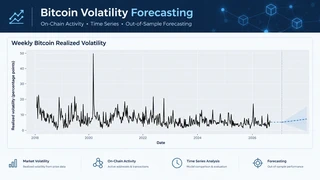 Bitcoin volatility forecasting and on-chain activity analysis
Description
This research project investigates whether Bitcoin blockchain activity can improve forecasts of future realized volatility compared with models based only on historical market data.
The central research question is:
Can on-chain information improve one-week-ahead forecasts of Bitcoin realized volatility?
The project focuses on volatility forecasting rather than predicting Bitcoin returns, with potential applications in market-risk assessment, portfolio management, and hedging.
Data
The analysis uses cryptocurrency market and blockchain data obtained from Coin Metrics.
The dataset contains 3,189 daily observations covering the period from January 1, 2018 to September 24, 2026.
After calculating daily returns and retaining complete seven-day weeks, the final forecasting dataset contains 454 weekly observations from January 8, 2018 to September 20, 2026.
Variables
The main dependent variable is weekly Bitcoin realized volatility, calculated from daily Bitcoin returns within each week.
Blockchain activity is represented by two explanatory variables:
- Weekly average active addresses
- Weekly confirmed transactions
The resulting dataset is designed to test whether network activity contains predictive information beyond historical volatility alone.
Forecasting Methodology
The project will compare models with increasing levels of information:
- A baseline model using historical realized volatility.
- A time-series model such as HAR-RV (Heterogeneous Autoregressive Realized Volatility).
- Extended models incorporating on-chain activity variables as explanatory features.
The primary forecasting horizon is one week ahead.
The final 30% of observations will be reserved for out-of-sample evaluation, while the remaining observations will be used for model estimation.
Model Evaluation
Model performance will be evaluated using both in-sample and out-of-sample criteria.
During the training period, model fit will be assessed using information criteria such as:
- AIC
- BIC
Out-of-sample predictive accuracy will be evaluated using:
- MAE (Mean Absolute Error)
- RMSE (Root Mean Squared Error)
The main objective is to determine whether incorporating blockchain activity improves forecast accuracy relative to models based exclusively on historical market information.
Research Motivation
Bitcoin volatility is highly time-dependent and can change substantially during periods of market stress.
Blockchain activity provides an additional source of information generated directly by the Bitcoin network. The project therefore examines whether variables such as active addresses and transaction activity contain useful predictive information about future realized volatility.
Rather than simply testing correlation, the study focuses on out-of-sample forecasting performance, which provides a more direct test of the practical predictive value of on-chain information.
Current Status
Ongoing Research Project
The current stage establishes the research question, dataset, variable construction, forecasting framework, and evaluation methodology. The empirical comparison of the forecasting models and the final out-of-sample results are part of the ongoing research process.
Tools & Technologies
- R
- Time Series Analysis
- Financial Data Analysis
- Bitcoin Blockchain / On-Chain Data
- Forecasting & Statistical Modeling
- Out-of-Sample Evaluation
Expected Outcome
The project aims to determine whether blockchain activity provides statistically and practically useful information for forecasting future Bitcoin volatility.
More broadly, it evaluates whether incorporating network-level data can improve traditional volatility forecasting approaches based on historical market dynamics.

Mathematics and Computer Engineering student with a focus on the intersection of rigorous theory and high-performance implementation. With a background marked by 23+ “Matrículas de Honor” and multiple Regional Olympiad awards, I thrive on bridging the gap between abstract mathematical models and efficient computational systems.
My core interests lie in Quantitative Finance, Stochastic Calculus, and Numerical Optimization. I am particularly passionate about transforming complex financial frameworks into high-performance algorithmic solutions. Currently, I balance my research in Quant Finance and Deep Learning with active leadership in university commissions.